Top Menu

Blog Archive

Blogger news

Blogroll

Blogger templates

Followers

Showing posts with label Hinduism. Show all posts

Why is ghee lamp preferred to oil lamp during puja ritual?

23:59

Contents


Namaskar! We heartily welcome you all for this Satsang (spiritual meet)! Before we commence this Satsang let us pay obeisance at the Holy feet of Sadguru (spiritual master) so that by His grace the very objective of this Satsang is fulfilled. Please pay mental obeisance to your personal icon of faith and recite as follows:
गुरुर्ब्रह्मा à¤—ुरुर्विष्‍णु à¤—ुरुर्देवो à¤®à¤¹ेश्‍वर: ।
गुरु à¤¸ाक्षात्‌ à¤ªà¤°à¤¬्रह्म à¤¤à¤¸्‍मै à¤¶्री à¤—ुरवे à¤¨à¤®: ।।

Worship of a deity is a subject of faith for all of us. We build a temple room in our house and decorate it well. We also keep the images or idols of the deities we like and perform daily puja (ritualistic worship).We purchase the articles of puja according to our capacity. We are also quite familiar with such articles like kalash (a water vessel generally of metal), shankh(conch ), a copper plate, a copper vessel, a small spoon, a lamp etc. Every article of puja has its own significance. Let us understand the significance of an important article of puja that is lamp.

1. Importance of lamp in Hindu Dharma

The lamp has its own special place in Sanatan Vaidik Hindu Dharma. It is a form and a symbol of Tej (Absolute fire principle). The lamp is invoked as, ‘तमसो मा ज्‍योतिर्गमय ।’ meaning the lamp leads us from darkness towards light. It burns only to give message of peace and light to the man. This is its greatness. In this Satsang we shall try to understand what the scriptures have to say about the lamp. Amongst the articles of puja the lamp is an important article. The following mantra which is recited during the ritual of puja explains its significance.
भोदीपब्रह्मरूपस्‍त्‍वं à¤œ्‍योतिषांप्रभुरव्‍यय: ।।
आरोग्‍यंदेहिपुत्रांश्‍चमत:शांतिं à¤ª्रयच्छमे ।।

Meaning: O Deity of lamp, you are of the form of Bramhan (the absolute truth). You are full of radiance. You never wither. Please bestow me health and good progeny and please fulfill my wishes.

2. Characteristics of oil and ghee lamps

Agni Puran clearly states that only oil or Ghee (clarified butter) be used in the lamp meant for puja and no other combustible substance. According to the Science of spirituality the lamp with clarified butter is more sattvik (spiritually pure) as compared to lamp in which oil is used. This is an important aspect which we will try to understand in details. So let us see the difference between the the lamp in which Ghee is used and the one with oil.
Generally the use of oil is more prevalent than that of Ghee. The oil containing lamp kindles longer while the ghee containing lamp kindles for a short period. Now let us see the difference from the spiritual view point.
  • Ghee lamp has more capacity to attract the sattvik vibrations present in the surrounding atmosphere as compared to oil lamp.
  • The oil lamp can attract the sattvik vibrations spread over a maximum distance of 1 meter while the ghee lamp can attract sattvik vibrations spread over till Swarga Lok (heaven)
    * When the oil or ghee gets exhausted or the lamp stops burning for some other reason then both the oil and ghee lamps are affected at spiritual level to some extent.
  • When the oil lamp stops burning the predominance of raja particles in the atmosphere is enhanced and lasts for half an hour. On the other hand when the ghee lamp stops burning the impact of sattvikta (the quality of being sattvik) on the atmosphere is experienced even after four hours.
Now let us see the characteristics of kindled lamps containing oil and ghee from spiritual angle with the help of a subtle drawing. Here we have to take into consideration the fact that while the vibrations of a subtle drawing are three dimensional we see them in the subtle drawing in a two dimensional form. For example the sphere will appear as a circle. Now let us look at the subtle drawing:
Subtle drawing of oil lamp

The yellow coloured circles seen in this drawing emit divine consciousness (chaitanya) in the atmosphere. The red coloured circles are of radiant energy. The burning flame is emitting frequencies full of Tej tattva (absolute fire principle) in the atmosphere. The red particles which you see here are the emitted particles of energy. So you have seen in this drawing how a oil lamp emits energy in the atmosphere. Now let us observe the subtle drawing of ghee lamp. The blue colour just besides the flame is indicative of spiritual emotion (bhav). The yellow circles which you see here are of chaitanya in the form of Tej tattva projecting in the atmosphere. You can also see the red particles and rays consisting of energy projecting into atmosphere.
Subtle drawing of ghee lamp

2.1 Effect on the worshipper as per Kundalini Yog

Now let us see the effect of both types of lamp on the worshipper.
  • The oil lamp generates a subtle armour of inferior quality around the worshipper while ghee lamp generates a subtle armour of superior quality.
  • The subtle frequencies emitted from the oil lamp activate the Mind-energy (Manashakti) of the worshipper whereas the subtle frequencies emanating from the ghee lamp activates soul energy of the worshipper.
According to yogic path of Kundalini Yog there are seven principle chakras or energy centers in the human being. These chakras influence practically every aspect of human being including physical body, mind and intellect. The oil lamp is effective in purification of Muladhar and Swadhishthan Chakra only to certain extent but the ghee lamp purifies Manipur and  Anahat chakras to a significant  extent.
Just as there are seven chakras in the human body, there are paths for the flow of vital energy (chetana). These are called as Nadis or channels. The three principle nadis are Chandra nadi (Moon channel), Surya nadi (Sun channel) and Sushumna nadi.When Chandra nadi is active the person perceives coolness. The activation of Surya nadi imparts energy to the person. The Sushumna nadi is activated when the person starts progressing spiritually. The oil lamp activates the Surya nadi of the person while ghee lamp activates only that nadi which is essential to the worshipper in a particular action.

2.2 Effect on the subtle sheaths of the worshipper

According to the science of spirituality the body which is visible to our eyes is called Annamaya Kosha or food sheath. Besides this there are four other Koshas namely Pranmaya Kosha or vital air sheath, Manomaya Kosha or the mental sheath, Vidnyanmaya Kosha or sheath of intellect and Anandmaya Kosha or bliss sheath. The Pranmaya kosha  is a seat for the Pancha pranas (five vital air elements) which provides energy to the gross body. The second Manomaya kosha is the seat of emotions. The third Vidnyanmaya Kosha is the seat of intellect and the fourth Anandamaya Kosha is the seat of Soul which is of the nature of existence, consciousness and bliss (satchidananda). Even these subtle sheaths or koshas are affected by the oil or ghee lamps. The oil lamp imparts power to the raja paricles in the Pranamaya kosha which makes the individual rstless. The ghee lamp strengthens the sattva particles of Pranamaya kosha and Manomaya Kosha and as a result of this the jiva (individual, embodied soul) becomes peaceful,stable and happy.

2.3 Spiritual experience imparted by oil and ghee lamps

Now let us compare the spiritual experiences obtained due to oil and ghee lamps. But before that let us understand what we mean by Spiritual experience or Anubhuti. We are used to appreciate this world through  the media of five sense organs namely nose, ears, eyes, tongue, skin , mind and intellect. This is known as experience. But when we experience something without the participation of all these then it is known as spiritual experience. Now let us compare the spiritual experiences obtained due to oil and ghee lamps. The oil lamp gives us spiritual experience of Pruthvi tattva (absolute earth element) and Aap tattva (absolute water element). For example if we get an experience of fragrance without the actual presence of an object which can impart such fragrance then it is a spiritual experience of Subtle fragrance or gandha. The fragrance is related to Pruthvi tattva. The example of spiritual experience of Aap tattva is dwelling sweet taste in the mouth.
When we see subtle light or vision of a deity then it is an example of spiritual experience related to Tej tattva or absolute fire element. When we experience a feeling of touch without any external reason  then it is a spiritual experience related to Vayu tattva or absolute air element. The ghee lamp gives spiritual experience of Tej tatva and Vayu tattva to the worshipper.

2.4 Why only ghee prepared from cow's milk should be used?

Generally any oil lamp emits frequencies consisting of raja particles but the sesame oil emits some sattva frequencies also. Therefore the lamp with sesame oil is comparatively more sattvik. However the ghee lamp emits the sattvik frequencies in  maximum amount compared to any oil lamp. Here we have to remember one thing that it is useful use ghee prepared only from the cow’s milk in the lamp lit in front of Deity. This is because in such ghee the Deites’ principles are already existent. Such a ghee which is dominant in sattva component emits luminous figures in the atmosphere. Such luminous figures are forms of Tej tattva or absolute fire element. Thus even though the use of ghee is recommended because of its capacity to emit maximum sattva frequencies, we can use sesame oil lamp if the use of ghee is not possible because of financial restraints or otherwise.

2.5 Points to be considered while using a lamp

Now let us see the points to be noted while actually using a lamp.
  • Do not kindle an oil lamp with a ghee lamp and vice versa
  • Do not kindle one lamp with another similar lamp. For example if there are two niranjans (a type of lamp) in an arti platter then do not light one niranjan with another niranjan. Similarly do not light one pillar of lamps with another.
  • Sometimes while performing puja we unknowingly touch the lamp. We should immediately wash our hands then. This is because when we worship a deity the sattva component of the lamp increases. When we touch the lamp the raja-tama particles from our body enter the lamp by way of touch. This reduces the purity of the lamp. The water has the property of encompassing everything. Anything which is offered to a deity through the medium of water reaches Him/Her faster. When we wash our hands we are one way dissolving our sins in the water. The spiritual practice of water is to assimilate in itself sins done by all. The extremely merciful Deities absolve us from our defects when we offer them at their feet through the medium of water.

3. Should electric bulbs be used instead of ghee lamps?

Now a days we see electric bulbs in use during the puja ritual instead of ghee lamp. What is the difference between two from the point of view of Spiritual science?
Some people may be finding it funny to worship a lamp of oil or ghee when the modern scientific era has offered us so much glitter by way of electrical bulbs. But our ancestors have given priority to the worship of lamp after profound experience and through the attitude of gratitude. Let us now compare the electrical bulb and the lamp with ghee. The light emitted from the electrical bulb blinds our eyes while the gentle flame of ghee lamp reminds us of Atma-Jyoti or flame of soul. The electrical bulb makes us extroverted and then the mind runs towards external objects. The ghee lamp makes us to look inwards. Thus we have seen the difference between the electrical bulb and ghee lamp. Now let us see the subtle drawing of an electrical bulb.
Subtle drawing of electrical  bulb

We can see here that via the medium of electrical current black frequencies are entering into the electrical bulb. These then activate frequencies dominant in tama component. The electrical bulb emits circles of tama component. In addition we can see that colliding black particles are emitted in the atmosphere.

4. Five wicks and single wick lamp

There are other varieties of the lamps also such as lamp with a single wick and lamp called niranjan wherein five wicks are used. The Niranjan with five wicks is symbolic of duality that is the manifest energy of a deity, whereas the lamp with a single wick attracts sattvik frequencies the lamp with five wicks attracts waves with destroyer property and dominant in raja component. The niranjan with five wicks denotes the relation of Panchpran (five vital air principles) with the Atmajyoti (flame of soul). Niranjan is used for waving Pancharati. Every  single flame of niranjan is symbolic of Atmajyoti. Pancharti means invocation of God with the help of panchparanas.While performing Pancharti we should have such a spiritual emotion that the Atmajyoti is kindled in me with the help of five panchaprans present in the body and I am performing the arti with such flame.

5. Why should a straight wick be used as compared to puffed up wick?

Now let us understand about straight wick and wick with one end puffed up (fulwat). During puja ritual a lamp is offered at various steps of the ritual according to purpose. For example performance of arti. Two types of wicks are used in the lamp namely Puffed wick and straight wick. Nowadays a puffed wick is used in a ghee lamp or niranjan and used as lamp of worship. The wick is puffedup from below to offer it stability to stand in the center of niranjan. The puffed wick is used in a ghee lamp. This type of wick is relatively of recent origin.The second type of wick which we all are familiar with is straight wick. Two straight wicks are joined together like a thread and used in a lamp. Not only there is difference between the two on a gross form but also on spiritual level.
  • The lower portion of the fulwat is puffed up while the straight wick is whole like a thread.
  • The fulwat is representative of various raja thoughts in the mind while straight wick is symbolic of detachment and also represents the thread which joins Panchaprans with Atamjyoti.
  • When a fulwat is kindled the inferior deities are attracted to it while the straight wick when kindled attracts principles of higher deities.
  • The frequencies emitted by the fulwat are of circular form while those emitted by straight wick are in the form of waves.
  • The colour of the divine consciousness emitted by the fulwat is redish yellow while that emitted by straight wick is of yellow colour.
  • Sattvik earth frequencies get attracted towards fulwat while more sattvik frequencies moving in the upward direction are attracted towards straight wick.
  • The atmospheric frequencies get momentum due to fulwat while their momentum is slowed down by the use of straight wick.
  • An armour of Pruthvi (absolute earth element) and Aap tattva (absolute water element) is generated around the worshipper by use of fulwat while straight wick generates an armour of Tej tatva (absolute fire element) around the worshipper.
According to science of spirituality Tej tattva is more powerful than either Pruthvi tatva or Aap tattva. As a result the use of fulwat imparts heaviness to the physical body while the use of straight imparts cheerfulness to mind.
Thus we have seen the difference between the fulwat and straight wick and also why it is important to use straight wick.

Hindu Symbols

05:08
As Hinduism is the oldest religion on the earth, it has more numbers of symbols than other religions. Each Hindu symbol has a different meaning and is used on different occasions. Hinduism symbols are also used as body tattoos in the Western countries as well as in India. Hinduism signs and symbols are very popular in India and are also known as Indian symbols. We are providing here a comprehensive list of major Hindu symbols and their meanings.

Om or Aum:
Aum, also known as, Om, is the most important symbol in Hinduism. It is made up of three Sanskrit letters namely A, U, and M and is written as No. 3 with a curved line like a tail going out from the center on the back side of three with a moon-shaped curve and a dot above 3. All the major Hindu mantras start with AumAum represents Brahman, the Almighty. You would understand the importance of this symbol by this only. It is the sound heard at the time of creation of universe.It is considered as sacred and is worn in pendants, rings, printed on T-shirts, cups, temple walls.
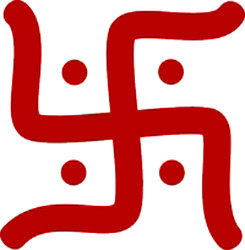
2. Swastika:
Swastika is the second most important Hindu symbol. Swastika looks like the Nazi symbol. The only difference is Nazi symbol is tilted as if standing on one point while the Hindu symbol seems as if standing on a horizontal branch. The word Swastika can be broken as Su+Asti+ka where Su means good and Asti means “it really is” and “ka” makes the word a noun. That means “Everything is good.”
Swastika is also considered to be sacred and represents luck and prosperity. ASwastika is drawn on Kalash at the time of Hindu rituals. It is also used in pendants and printed on walls of the Hindu temples.
3. Tilak:
Tilak is a vertical sign made by kumkum on the forehead exactly between two eyebrows of a Hindu male. This is used mainly at the time of rituals or any religious ceremonies like weddings, birthdays, Munj, etc.

4. Lingam:
Lingam
Lingam is the representation of Lord Shiva through which Lord Shiva is worshipped mostly. The lingam is also called Shivling, Ling. It is a vertical cylindrical pillar surrounded by a nearly completely round object with an opening on the right side which stretches out to some length.
The interpretation of this Hindu symbol is controversial as some people believe that it is a union of the Linga of Shiva and Yoni of Shakti while others believe that it represents the infinite nature of Shiva. Most of the Hindus worship Lord Shiva in the form of a lingam instead of an idol of Lord Shiva.

5. Trishul:

Trishul is the main weapon of Lord Shiva which he always carries with himself and is highly revered in Hinduism.
Trishul is a weapon with three points residing on a long rod with outer two points curved at the end and the middle point straight and sharply pointed.

6. Bindi:

 
A bindi is a small rounded sign made with Kumkum between the two eyebrows of a married Hindu woman. Though unmarried girls also use the sign but they do not use Kumkum for that.
 7. Kalash:

Kalash is a vessel with five green leaves placed at the entrance of the vessel in such a way that they cover the entrance of the vessel and then a coconut placed on top.


8. Yantra:

 Yantra actually means a machine but when it is used as a Hindu symbol, it looks like a geometry figure. These are simple as well as complex figures. Sometimes numbers are written on it. If placed at a desired place, they are believed to have good effects on the life of the possessor.
 9. The saffron-colored flag:


The saffron-colored flag is the official flag of Hinduism. It looks like two partial triangular waves connected to each other in the middle and flat at the other end. Saffron color represents sacrifice and renunciation of materialism.


10. Rudraksha Bead:

Rudraksha is a tree whose seeds are traditionally used by Hindus for medicinal as well as spiritual purpose. Rudraksha is a dark-brown colored seed with some linings on it. Rudraksha is believed to be of 1 to 108 faces. One-faced Rudraksha is scarcely available.

11. Lotus:
The flower of lotus is of great importance in Hinduism. It represents culture and politeness. You will see lotus in the hands of some important Hindu deities such as Lord Ganesha and some goddesses. A main Hindu deity Brahma is always shown sitting in the big lotus. The flower of lotus is used in some Hindu rituals.

12. Shankha (Conch Shell):
Shankha is used both as a symbol and as a trumpet in Hindu rituals. Shankha is a sea shell which is kept inside Hindu altars and worshiped. Shankha is an emblem of Hindu God, Lord Vishnu. Shankha is a symbol of longevity and prosperity for Hindus.
In ancient times, Shankha was used as a trumpet before the start of the war.

13. Dharmachakra:

 
Dharmachakara, means the Wheel of Dharma, represents Hindu Dharma or law. This wheel has eight spokes to it.

14. Lamp:
You will always find this lamp near the Hindu altar and/or in Hindu temples. Hindus believe that a lamp should always be lit near the Hindu deities. Many cultural and social functions in India are opened with lighting the lamps by chief guests. This lamp symbolizes the light and hence is sacred.


15. Banyan Tree:
Banyan tree is a Hindu symbol of longevity. It is not only a Hindu symbol but also is national tree of India. Hindu married women worship this tree on Vat Pournima and tie a white thread around it asking for the longevity for their husbands.
 16. Nandi:
Nandi is a bull which is also the carrier of Lord Shiva. A nandi is always found in front of a Shivlinga. It is a symbol of Lord Shiva. It represents strength and fertility.

17. Shri:
 Shri or Sri is another most important symbols of Hindus. Shri represents auspiciousness. It also is one of the names of Lord Ganesha. Shri is added before the names of Hindu males as Mr. is added in English. It is used as short form of Shriman in this regard. It is also a symbol of Devi Laxmi.

18. Ganesha:

 
Lord Ganesha is an important demi-God of Hindus but he is also used as a symbol many times. This symbol represents auspiciousness as Ganesh is known as remover of obstacles. Lord Ganesha is worshiped first of all demi-Gods. Hindus wear Ganesha symbol as a pendant or print his pictures in the house. Some people use metal rings on which Ganesha is carved.

19. Kamandalu:
Kamandalu is an oblong vessel mainly used by ascetics who live in forests and do meditation. It is a symbol of asceticism. It is mainly used to store water. It looks like a Kalash but it is different from it.
 20. Cow:
 Cow is the most sacred animal for Hindus. It is considered as a very poor animal. Cow is a symbol of good nature, purity, motherhood, and prosperity.
21. Sudarshan Chakra:
 Sudarshan Chakra is a weapon as well as a symbol of Lord Vishnu. It is considered as the most lethal weapon. It is circular in shape like a flat disc and is toothed as a saw around the circumference.
22. Veena: 
Veena is a musical stringed instrument of Goddess Saraswati but it is also a Hindu symbol of art and education. It is also associated with Dev Rishi Narad.
23. Paduka:

 
Paduka actually means footwear, the wooden slippers wore by saints and Hindu deities. Laxmi Paduka is the symbol of wealth. The footprints of Hindu deities and saints are also called as Paduka and are worshiped as a symbol of that deity.


24. Peacock Feather: 
The peacock feather is the symbol of Lord Krishna as he used to wear a feather in his crown. Sometimes, a flute with peacock feather is depicted as the symbol of Lord Krishna
.25. Symbols of a married Hindu woman: 
Hindu women wear some ornaments as a symbol of marriage including but not limited to Mangalsutra (the sacred thread), bangles, Jodawe (a silver ring wore in the toe), ear-rings, nose-rings, etc. These symbols vary according to the region. Different things are used as symbol of marriage in different parts and societies in India. Besides those, Hindu married women apply Kumkum between the two eyebrows and on the center of the head.
26. Sun: 
Sun is considered as a deity by Hindus and is also a symbol of light and truthfulness. Sun worship is still prevalent in Hinduism. People offer water to the sun in the morning.
27. Snake:
 Snake is a symbol of rebirth as it casts its skin after a period of time. Lord Shiva always wears a cobra around his neck and Lord Vishnu rests on a snake named Sheshnaga.